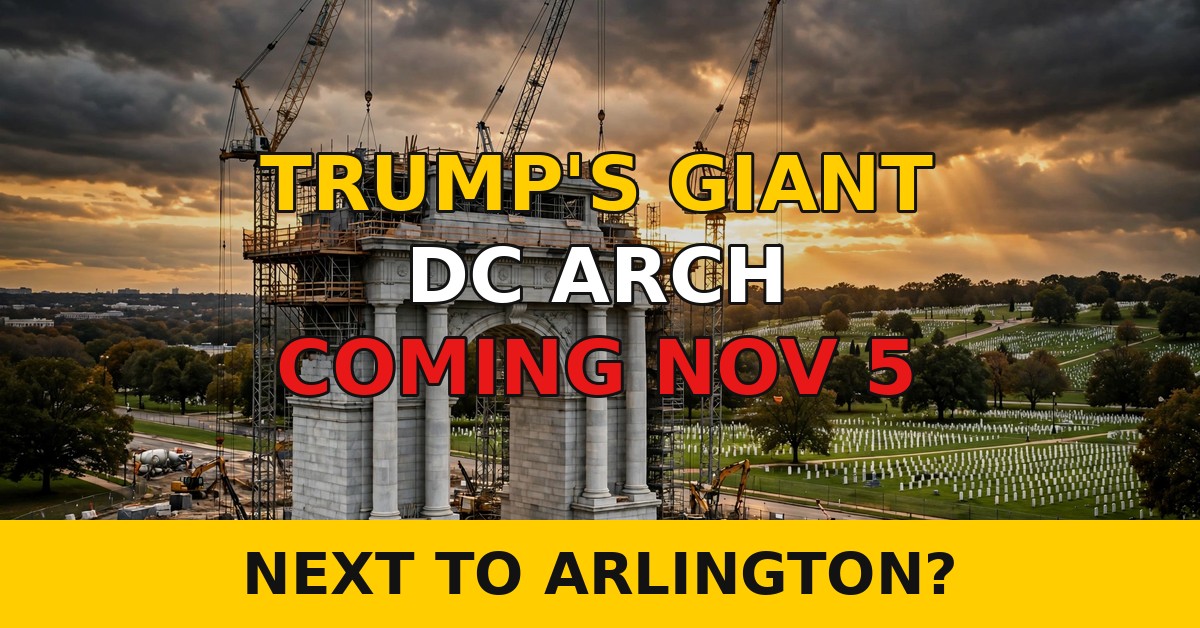
Construction on President Donald Trump’s controversial 250-foot triumphal arch in Washington could begin as early as November 5 — two days after the November 3 midterms. The date was revealed in a Trump administration court filing Wednesday, per CNN, setting off a fresh wave of opposition. The Trump DC arch has been fought over for months by veterans, preservationists, and city planners. Now it has a start date, and the timing could hardly be more politically charged.
What the Trump DC Arch Is — and Why November 5 Matters
The monument would be a 250-foot triumphal arch — a scale more associated with Paris or ancient Rome than the modern Washington skyline — standing opposite Arlington National Cemetery, where nearly 430,000 military personnel, veterans, and family members are buried.
Two approvals still stand in the way: the National Capital Planning Commission meets November 5 on the final plans, and construction also needs Interior Department authorization. The administration’s filing suggests November 5 is when the project could move from paper to earthmovers.
The date is what everyone’s talking about. For the Trump DC arch project, breaking ground two days after the midterms means bulldozers could arrive before election-night dust settles. Supporters call it efficiency; critics call it a fait accompli rushed through while the country is distracted.
A Monument Across From the Fallen
Location is the heart of the fight over the Trump DC arch. The proposed arch would rise directly opposite Arlington National Cemetery — ground where nearly 430,000 service members, veterans, and their families rest.
Veterans argue the massive structure would disrupt the cemetery’s peaceful atmosphere. Arlington isn’t a tourist attraction; it’s a place of mourning. A 250-foot monument looming across the river changes the character of that space in a way no rendering can capture.
Preservationists say the arch would damage views of historic Washington landmarks. The capital’s sightlines — the Mall, the monuments, the cemetery — have been protected for generations because they’re irreplaceable. Once a 250-foot arch goes up, there’s no going back.
Drones, Snipers, and Lawsuits
The Trump DC arch comes with one of the more unusual justifications in monument history. Trump has claimed the arch would serve a national security purpose — housing military drones, snipers, and ammunition. That claim has raised eyebrows among security experts, preservationists, and just about everyone else.
An Interior Department spokesperson defended the proposal differently, saying it would “enhance the visitor experience at Arlington National Cemetery for veterans, the families of the fallen, and all Americans alike.” That’s the official line: better visits, not a military installation. The gap between the two is one reason critics are skeptical.
Meanwhile, the project has drawn multiple lawsuits and significant criticism from preservation groups, challenging everything from the approval process to planning-rule compliance. The administration’s court filing — the same one that revealed the November 5 date — suggests it’s pushing ahead anyway. Courts move slowly. Bulldozers don’t. That’s what opponents of the Trump DC arch fear most.
The Timing Question Nobody Can Ignore
The midterms are November 3; the planning commission meets November 5. The symmetry is impossible to ignore — and both sides are reading it their way.
For backers of the Trump DC arch, it’s simple scheduling. For critics, it’s a tell — construction starting days after the election, in the afterglow or wreckage of the midterms, when attention is elsewhere. If Republicans hold Congress, the arch proceeds with a tailwind. If Democrats take the House, it becomes an instant symbol of defiance — or a target for defunding.
Either way, the arch is now part of the post-election reality. A 250-foot monument across from Arlington, begun 48 hours after Americans voted, will read politically whatever the official line says.
Sources and Resources
- The News: Trump’s massive DC arch could begin construction days after US midterm elections — reports the November 5 construction date revealed in the Trump administration’s court filing, the NCPC meeting, and the Interior Department’s defense of the project.
- The White House — official statements and executive actions from the Trump administration.
- Congress.gov — official source for legislation and resolutions related to federal monuments and the National Capital Planning Commission.
- World Reach Daily — more politics news and Trump DC arch coverage from our newsroom.
Why are veterans so upset about this?
Arlington is where their friends, family members, and fellow service members are buried — 430,000 of them. Veterans opposing the arch say a 250-foot monument across the river would shatter the cemetery’s quiet, solemn atmosphere. To them, it’s a vanity project imposed on a place of grief.
Can the president just build a monument in D.C.?
Not unilaterally. Projects like this need National Capital Planning Commission sign-off and Interior Department authorization. That’s why the November 5 meeting matters — it’s one of the last formal gates before construction can begin.
What’s the deal with the drones and snipers claim?
Trump has said the arch would serve national security by housing military drones, snipers, and ammunition. The Interior Department’s official defense is more conventional — enhancing the visitor experience at Arlington. The gap between the two is one reason critics are skeptical.
Who’s suing to stop it?
Multiple lawsuits have been filed, along with sustained criticism from preservation groups. The legal challenges target the approval process and the monument’s compliance with planning rules. The administration is pushing ahead anyway — which is exactly what the lawsuits are trying to prevent.
Could Congress stop the arch after the midterms?
Potentially. Congress controls federal funding and can restrict money for projects like this. If Democrats take the House on November 3, expect the arch on someone’s oversight agenda fast. If Republicans hold, it probably sails through.
Conclusion
The Trump DC arch was already controversial. A November 5 construction start — two days after the midterms — makes it political dynamite. Veterans see a desecration of sacred ground. Preservationists see an irreversible scar on the capital’s skyline. The administration sees a monument that will enhance the visitor experience for veterans and the families of the fallen. The lawsuits are live, the commission meets November 5 — the bulldozers are waiting. Whatever Americans decide on November 3, they’ll wake up two days later to construction across from Arlington. Whether that’s a triumph or a tragedy depends on where you’re standing.