
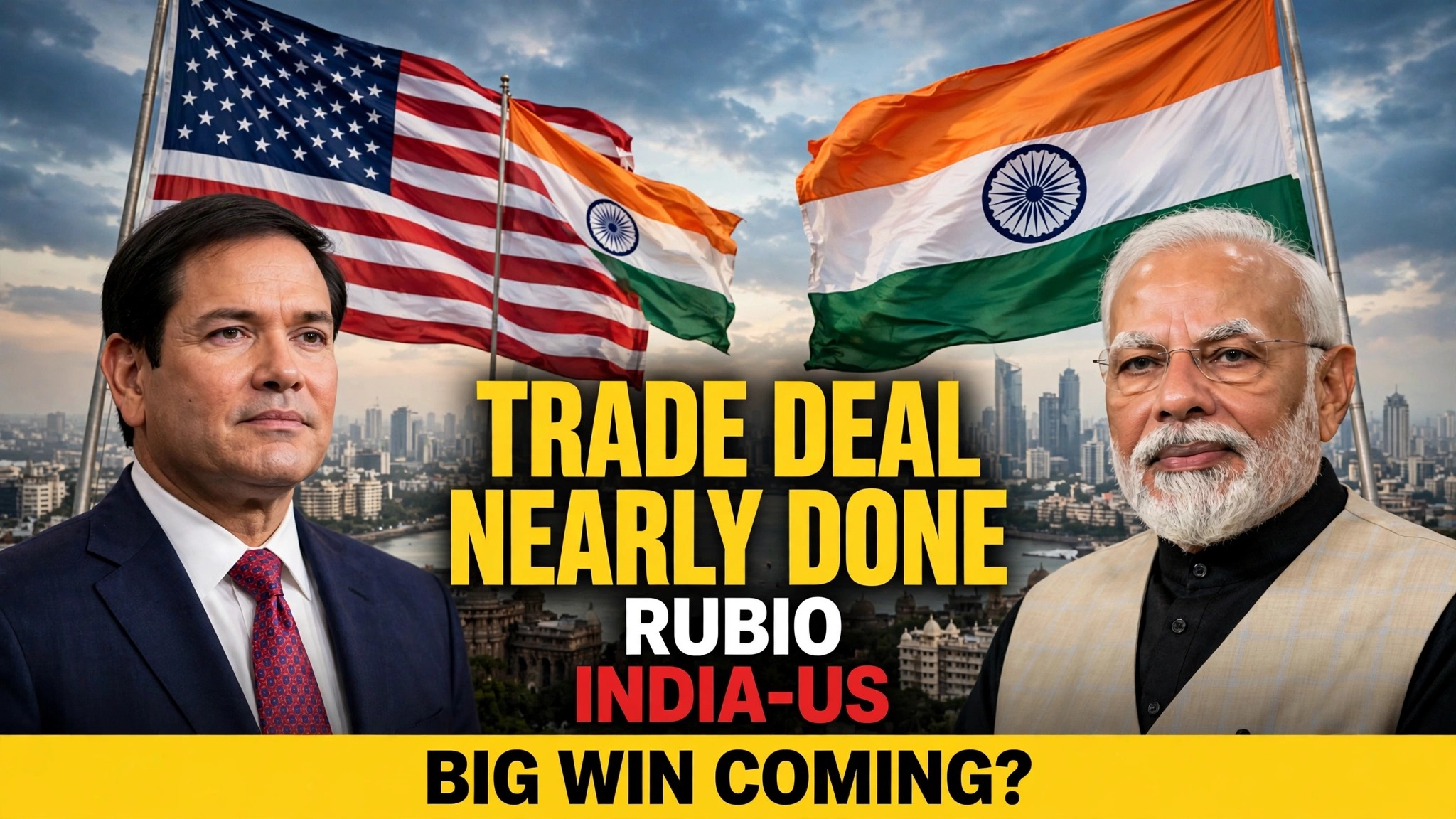
The India US trade deal is almost done. That was the message U.S. Secretary of State Marco Rubio carried into Mumbai on Tuesday, October 20, 2026, as he began his second visit to India with one headline objective: close out the India US trade deal both governments have been negotiating for months. “We’re very, very close,” Rubio told reporters, adding that only a small number of issues remained before the ink could go on the India US trade deal.
Rubio touched down at Chhatrapati Shivaji Maharaj International Airport around 2:15 in the afternoon local time, kicking off a packed schedule that ranged from a solemn tribute to terror victims at the Taj Mahal Palace Hotel to a gala reception marking 250 years of American independence. But the real business of the day sat in between: a one-on-one meeting with India’s External Affairs Minister S. Jaishankar, where the India US trade deal shared the table with energy, defense, and technology.
India US Trade Deal “Very Close,” Rubio Says
Standing near Mumbai’s iconic Gateway of India after meeting Maharashtra Chief Minister Devendra Fadnavis, Rubio sounded as upbeat about the India US trade deal as American officials have been in months.
“We’re very, very close. I would say we’re about as close as you can be without having executed the agreement,” he said. “I think there’s a small number of items left to wrap up, so I think that will happen shortly.”
He went further: “We’re hoping, which it should, and hopefully have some good news to announce soon and sign it thereafter. So, we’re very optimistic that we will have something in place here very soon.”
U.S. Ambassador to India Sergio Gor joined Rubio for the meeting, along with Rubio’s wife, Jeanette Dousdebes Rubio. The tone was warm, deliberate — the kind of body language diplomats use when the heavy lifting is mostly behind them and the remaining work is about sequencing and optics.
Negotiations over the India US trade deal have dragged on far longer than either side wanted. For New Delhi, the agreement promises deeper access to the American market and a reset after years of friction over tariffs and market access. For Washington, it offers a stronger economic anchor in the Indo-Pacific at a moment when the U.S. is reworking supply chains and energy flows. Both sides know a signed deal would be a political win. Neither wants to be the one seen stalling it.
A Packed Day in Mumbai
Rubio’s Tuesday followed a tight script drawn up by India’s Ministry of External Affairs. Shortly after landing, at 3:40 p.m., he took part in a wreath-laying ceremony at the Taj Memorial inside the historic Taj Mahal Palace Hotel, honoring victims of terrorism. The hotel was the site of the 2008 Mumbai attacks, and the stop carried real weight: earlier this week, Rubio heard a firsthand account of the 26/11 attacks from a former Taj security chief who was present that night.
The choice wasn’t accidental. Counterterrorism has long been one of the sturdiest pillars of the India-US partnership, and both governments routinely use visits like this to signal that the security bond underpins everything else — including the India US trade deal.
At 3:50 p.m., the two top diplomats sat down for bilateral talks at the same venue. Jaishankar, who had spent part of the day meeting a visiting U.S. Congressional delegation in Mumbai, came into the room having already tested the temperature with American lawmakers.
In a post on X, Jaishankar said he had met a delegation including Reps. Jason Smith, David Schweikert, Elise Stefanik, Andy Ogles, and Friedman, and that they had discussed “trade, energy, security and technology aspects of our relationship,” plus ease of doing business in India and Indo-Pacific cooperation. Those are the same four lanes the Rubio-Jaishankar meeting was expected to cover.
Later in the evening, at 6:35 p.m., Rubio headed to the Jio World Convention Centre for the “Freedom 250 Reception,” celebrating milestones in U.S. history and bilateral ties. Jaishankar attended as Guest of Honour. On Wednesday, October 21, Rubio was scheduled to fly to Jamnagar, Gujarat, departing Mumbai at 10:30 a.m. — a stop with a very specific purpose.
“India Is a Refining Superpower”
Energy was arguably the second-biggest item on Rubio’s agenda after the India US trade deal, and he came with a pitch he clearly wanted heard.
“India is a refining superpower. They have the capability to refine heavy crude. They’ve done so in the past, and I think as more and more Venezuelan oil comes online, it’s something they can do,” Rubio said, pointing to India’s existing oil concessions in Venezuela that could help boost production.
He added that the American delegation would engage in discussions with Reliance regarding oil production in Venezuela — a striking signal about where Washington sees global energy supply heading.
“I’m not claiming to you that Venezuela alone can fill the hole that could be caused by some of the things that are happening around the world, but I think over time, it most certainly can, and in the short term, it can certainly help,” he said.
That explains the Jamnagar leg of the trip, where energy talks will run parallel to the India US trade deal endgame. The Gujarat city is one of the world’s biggest refining hubs, and a visit there lets the Americans talk energy security in front of the hardware. For India, it’s a reminder that Washington sees New Delhi not just as a buyer of energy but as a processor for the world — a role that comes with real geopolitical leverage.
The Road to Mumbai Ran Through Samarkand
Rubio didn’t come to India straight from Washington. He arrived late Sunday in Samarkand, Uzbekistan, for talks with top officials from Kazakhstan, Kyrgyzstan, Tajikistan, Turkmenistan, and Uzbekistan — a Central Asia swing that underlined how Washington is competing for influence in a region rich in natural resources and sitting squarely in China’s shadow.
The sequencing matters. The U.S. is trying to build out economic and energy partnerships across South and Central Asia as one connected arc, and the India relationship is the anchor. A finished India US trade deal would let Rubio walk into those regional conversations with proof that American partnerships deliver concrete results.
Why This India US Trade Deal Matters Right Now
The timing of the visit — and of the India US trade deal push — is hard to miss. Earlier this month, Washington’s decision to waive sanctions on Russian fossil fuel sales eased India’s energy concerns — and drew criticism elsewhere. Rubio himself has called India an important ally in that context, and the trade deal sits in the middle of that bigger bargain: Washington gives New Delhi room to maneuver on energy, and New Delhi deepens its economic alignment with the United States.
There’s also a political clock ticking in the background. Midterm elections in the U.S. are two weeks away, and the India US trade deal — once signed — would be a headline the administration could point to. The Indians, for their part, have every reason to want the deal done while momentum is strong — and before any shifts in Washington’s mood.
For the business world, the stakes of the India US trade deal are practical. Indian-American businesses contribute an estimated $12.5 billion to the U.S. Southeast economy alone, a figure that was highlighted ahead of Rubio’s visit. A formal trade agreement would give those commercial ties a stronger institutional frame — lower friction, clearer rules, and a dispute-resolution structure both sides can live with.
What remains unclear is exactly which “small number of items” are still being haggled over. Neither side has published a list, and diplomats rarely do until the deal is signed. Historically, the sticking points in U.S.-India trade talks have included agricultural market access, digital trade rules, medical devices, and tariff levels on specific goods. Expect the final announcement to present whatever remains as technical details rather than disagreements.
What to Watch Next
Three things will tell us whether “very close” becomes “signed” for the India US trade deal. First, watch the language from both capitals in the coming days — if Indian officials start echoing Rubio’s optimism publicly, that’s a sign the endgame is real. Second, watch Jamnagar: if the energy conversations produce concrete announcements about Venezuelan crude or Reliance cooperation, the trade deal’s momentum is genuine, not staged. Third, watch for a signing date. Trade deals die in the gap between “close” and “signed,” and the fastest way to kill speculation is a date on a calendar.
For now, though, the message from Mumbai is the clearest it’s been in months: this deal is coming.
Sources and Resources
- Reuters — Indian foreign minister, Rubio to hold talks Oct 20
- Mathrubhumi English — India-US trade deal ‘very close’, says Marco Rubio
- The New Indian Express — Marco Rubio to arrive in India today as trade deal nears finalisation
- Live Mint — S Jaishankar, Marco Rubio to hold talks in Mumbai amid India-US trade deal push
- Republic World — US Secretary of State Rubio arrives in Mumbai for talks with Jaishankar
- World Reach Daily — more world news and analysis
When did Marco Rubio arrive in Mumbai for the trade talks?
Rubio landed at Mumbai’s Chhatrapati Shivaji Maharaj International Airport around 2:15 p.m. local time on Tuesday, October 20, 2026. It is his second visit to India as U.S. Secretary of State.
What did Rubio actually say about the trade deal?
His exact words were: “We’re very, very close. I would say we’re about as close as you can be without having executed the agreement. I think there’s a small number of items left to wrap up, so I think that will happen shortly.” He said he hopes to have “good news to announce soon and sign it thereafter.”
What topics did Rubio and Jaishankar discuss besides trade?
According to the Indian foreign ministry, the talks covered energy, trade and investment, defence, and critical and emerging technologies, along with regional stability and Indo-Pacific cooperation. Energy security — especially India’s role in refining Venezuelan crude — featured prominently.
Why is Rubio going to Jamnagar after Mumbai?
Jamnagar in Gujarat is a major global oil refining hub. Rubio is scheduled to fly there on the morning of Wednesday, October 21, to continue energy-focused discussions — part of Washington’s pitch for India as a key player in processing Venezuelan heavy crude for world markets.
Has the deal been signed yet?
Not yet. As of October 20, both sides described the agreement as nearly complete but not finalized. No signing date had been announced. The remaining items have not been made public.
Conclusion
Marco Rubio’s Mumbai visit did exactly what it was designed to do: put a public face on the India US trade deal both governments are desperate to finish. “Very close” isn’t “signed,” and diplomats have a long history of confusing the two. But the specificity of the itinerary — the Congressional delegation groundwork, the energy pitch in Jamnagar, the deliberate optimism from both sides — suggests this one is further along than the usual diplomatic spin. If the India US trade deal gets signed in the coming weeks, October 20 in Mumbai will be remembered as the day both sides stopped pretending it was still far away.